
In today’s digital world, businesses are not just competing for customers—they are competing for attention, relevance, and loyalty. Traditional marketing methods no longer guarantee growth. Brands need smarter strategies, data-driven decision-making, and innovative approaches to attract, engage, and retain customers.
This is where Growth Marketing steps in.
Growth marketing has become one of the most powerful approaches used by startups, e-commerce brands, SaaS companies, and digital marketers worldwide. Unlike traditional marketing, which focuses mainly on awareness and lead generation, growth marketing aims to drive measurable, repeatable, and scalable growth across the entire customer lifecycle.
In this comprehensive guide, you’ll learn:
- What growth marketing really means
- How it is different from traditional marketing
- Key principles and frameworks
- Tools and channels used
- Real benefits for businesses
- How beginners and professionals can apply growth marketing in 2025
- Growth marketing examples
- Step-by-step strategy to build your own growth plan
Let’s dive deep into the world of modern growth.
What is Growth Marketing?
Growth marketing is a data-driven, experiment-heavy marketing approach designed to acquire new customers, retain existing ones, and scale business growth across the entire funnel.
It combines creativity, analytics, technology, and psychology to discover the fastest and most cost-effective ways to grow a business.
In simple words:
Growth marketing = Marketing that focuses on long-term, sustainable, scalable growth through continuous experimentation.
Unlike traditional marketers who say:
“How do we get more leads?”
Growth marketers ask:
“How do we improve every touchpoint—from brand awareness to sales performance to customer retention?”
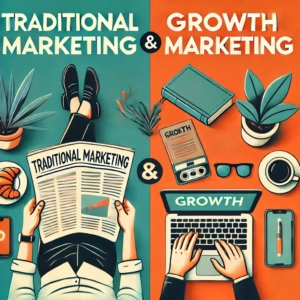
Growth Marketing vs Traditional Marketing
| Traditional Marketing | Growth Marketing |
| Focuses mainly on top-of-funnel | Focuses on full funnel (AARRR model) |
| Long-term campaigns | Fast experiments |
| Brand-focused | Result-focused |
| Limited channels | Multi-channel, data-driven |
| Creative-driven | Creative + analytical + technical |
| Hard to measure | Highly measurable |
| Fixed strategy | Flexible & constantly evolving |
In today’s competitive landscape, sticking only to traditional marketing is not enough. Growth marketing provides real-time optimization, making campaigns smarter and more effective.
Why Growth Marketing Matters in 2025
The digital world is changing fast:
- Higher competition
- Rising ad costs
- Smarter consumers
- Shorter attention spans
- AI-driven personalization
- Need for measurable ROI
Businesses that don’t adapt will fall behind.
Growth marketing helps you:
- Lower marketing costs
- Increase conversions
- Improve customer retention
- Predict customer behavior
- Build loyalty and community
- Scale revenue efficiently
This is why almost every successful digital brand uses growth strategies—from Amazon to Spotify to Airbnb.
The AARRR Funnel: The Heart of Growth Marketing
AARRR—also known as the Pirate Funnel—is the most widely used framework in growth marketing.
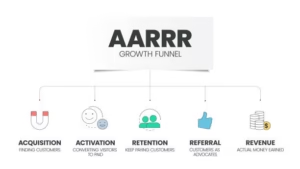
AARRR Stands For:
- Acquisition – Bringing new users
- Activation – Ensuring they have a great first experience
- Retention – Keeping them coming back
- Revenue – Converting into paying customers
- Referral – Encouraging them to refer others
Growth marketers analyze each stage to find growth opportunities.
Core Principles of Growth Marketing
Data-Driven Decisions
Every action is backed by numbers.
Growth marketers rely on analytics to understand what works and what doesn’t.
Constant Experimentation
They run A/B tests, landing page experiments, email tests, pricing experiments, and more.
Customer-Centric Approach
It focuses on providing value, solving pain points, and improving user experience.
Scaling What Works
If a strategy performs well, it is optimized and scaled for maximum returns.
Full-Funnel Growth
They don’t just think about leads—they think about lifetime customer value.
Skills Required for Growth Marketing

Growth marketers combine creativity with technology. Key skills include:
- Data analysis
- SEO & content marketing
- Paid ads (Google, Meta, LinkedIn, YouTube)
- Email automation
- CRO (Conversion Rate Optimization)
- A/B testing
- Product thinking
- UX psychology
- Social media
- Understanding marketing tools
- AI-driven optimization
They are hybrid professionals—part marketer, part analyst, part creator.
Growth Marketing Channels
Growth does not come from one channel; it comes from multiple coordinated channels.
Organic Channels
- SEO
- Content marketing
- Blogging
- YouTube
- Social media
- Communities
- Forums & Q&A platforms
- Product-led growth
- Referral systems
Paid Channels
- Google Ads
- Social media ads
- Display ads
- Influencer partnerships
- Affiliate marketing
Retention Channels
- Email marketing
- WhatsApp automation
- Push notifications
- SMS campaigns
- Loyalty programs
- Personalized recommendations
Offline Channels
- Events
- Workshops
- Print marketing
- Networking
Growth marketers build a strong ecosystem by combining multiple channels.
Tools Used in Growth Marketing
Modern growth marketing relies heavily on tools, automation, and AI.
Analytics Tools
- Google Analytics
- Mixpanel
- Amplitude
- Hotjar
SEO Tools
- Ahrefs
- SEMrush
- Google Search Console
- Moz
Email & Automation Tools
- Mailchimp
- HubSpot
- ActiveCampaign
- Klaviyo
A/B Testing Tools
- Optimizely
- VWO
- Google Optimize alternatives
Social Tools
- Buffer
- Hootsuite
- Meta Business Suite
The right tool stack helps speed up decision-making and optimization.
Benefits of Growth Marketing
Cost-effective
Because growth marketing focuses on experiments, you invest only in high-performing strategies.
Higher conversions
Optimization improves every customer touchpoint—landing pages, ads, emails, CTAs, etc.
Better retention
Loyal customers generate more revenue than new customers.
Sustainable growth
Growth marketing is long-term and builds repeatable systems.
Competitive advantage
Brands that use growth strategies scale faster and dominate markets.
Growth Marketing Examples
Example 1: Dropbox
Dropbox used referral marketing (give and get extra space) —resulting in 3900% growth in 15 months.
Example 2: Airbnb
Used user-generated listings + Craigslist integration to acquire millions of users.
Example 3: Hotmail
Added a simple line at the end of every email: “Get your free email at Hotmail.” It spread like wildfire.
Example 4: Spotify
Uses personalized playlists and recommendation engines to boost retention.
Example 5: Uber
Offered referral discounts that helped them penetrate global markets.
These examples prove growth marketing isn’t magic—it’s experimentation and smart psychology.
Growth Hacking vs Growth Marketing
Many people confuse these terms.
Growth Hacking
- Short-term
- Fast experiments
- Focused on rapid growth
- Popular in startups
Growth Marketing
- Long-term
- Sustainable growth
- Full-funnel strategy
- Works for companies of any size
Growth marketing includes growth hacking but is more strategic and stable.
How to Build a Growth Marketing Strategy (Step-by-Step)
Below is a practical framework you can apply in your business.
Step 1: Understand Your Audience
Use tools and surveys to identify:
- Pain points
- Interests
- Behaviors
- Motivations
Step 2: Map the Customer Journey
Identify touchpoints from awareness to conversion.
Step 3: Set Clear Goals
Examples:
- Improve signup conversion by 20%
- Increase traffic by 50%
- Reduce churn by 10%
- Increase email open rate
Step 4: Choose High-Impact Channels
Use insights to pick the right platforms.
Step 5: Start Running Experiments
Examples:
- A/B test landing page headline
- Test different pricing models
- Change CTA button color
- Test email subject lines
Step 6: Analyze Data
Look for patterns:
- What worked?
- What failed?
- What surprised you?
Step 7: Scale Winners
Once an experiment proves successful, invest more.
Step 8: Repeat Continuously
Growth is not a one-time setup—it is a continuous cycle.
Growth Marketing Strategies for 2025
AI-Driven Personalization
Platforms like ChatGPT, Jasper, and HubSpot AI help deliver personalized experiences.
Short-Form Video Marketing
Reels, TikTok, and YouTube Shorts are now essential for brand awareness.
Voice Search Optimization
Smart speakers and voice-enabled devices are growing rapidly.
Community-Led Growth
Brands build loyal communities to boost retention and referrals.
User-Generated Content (UGC)
People trust content created by users more than ads.
Marketing Automation
Automating emails, WhatsApp, and CRM increases efficiency.
Omnichannel Strategy
Customers want seamless experience across website, social media, apps, and offline.
Future of Growth Marketing
Growth marketing will continue evolving with AI, automation, hyper-personalization, and predictive analytics.
Future trends include:
- Predictive customer behavior modelling
- Zero-party data strategies
- Real-time personalization engines
- Gamified user journeys
- Advanced conversational marketing
Brands that adapt quickly will dominate their industries.
Key Components of a Successful Growth Marketing System
To succeed with growth marketing, businesses must create a strong foundation. Here are the core pillars:
Product-Market Fit (PMF)
Without PMF, no marketing strategy will work. It means your product solves a real problem and people genuinely want it.
Indicators of strong PMF:
- High repeat usage
- Positive customer feedback
- Organic referrals
- Low churn
- People willing to pay without discounts
PMF is the backbone of growth.
Data Infrastructure
To make data-driven decisions, your business should have:
- Website tracking
- Marketing analytics
- CRM system
- Customer journey mapping
- Funnel tracking
- Attribution modeling
Growth marketing is impossible without reliable data.
Creative Content Engine
Content drives awareness, traffic, trust, and conversions.
Your content engine should include:
- Blogs
- Infographics
- Videos
- Shorts/Reels
- Case studies
- Landing pages
- Lead magnets
- Email newsletters
Content is the fuel of growth.
Experimentation Framework
Growth teams must test fast and analyze faster.
A good experimentation framework includes:
- Hypothesis
- Setup
- Execution
- Evaluation
- Scaling
This cycle repeats forever.
Automation Systems
Automation saves time and improves customer experience.
Examples:
- Email sequences
- Abandoned cart reminders
- WhatsApp follow-ups
- Lead nurturing flows
- Personalized product recommendations
Automation = consistent growth.
Psychological Principles Used in Growth Marketing
Growth marketing is built on understanding human behavior. Here are powerful psychology triggers:
Social Proof
People trust what others recommend.
Examples:
- Reviews
- Ratings
- Testimonials
- UGC videos
- Influencer shoutouts
Scarcity
Limited availability increases urgency.
Examples:
- “Only 2 left!”
- “Offer ends today!”
Reciprocity
When you give value, people feel like giving back.
Examples:
- Free ebooks
- Free trials
- Free templates
Personalization
People engage more with messages tailored to them.
Examples:
- Personalized emails
- Personalized homepages
- Personalized recommendations
Anchoring
People base decisions on the first value they see.
Example:
- Showing original price before discount
- Premium plan displayed first
Growth marketers use these principles to optimize conversions.
Growth Marketing Metrics You Must Track
You cannot grow what you do not measure.
Key metrics include:
Acquisition Metrics
- Cost Per Click (CPC)
- Cost Per Lead (CPL)
- Customer Acquisition Cost (CAC)
- Organic traffic
Activation Metrics
- Landing page conversion rate
- Signup rate
- App install rate
Retention Metrics
- DAU (Daily Active Users)
- MAU (Monthly Active Users)
- Churn rate
- Repeat purchase rate
Revenue Metrics
- Average Order Value (AOV)
- LTV (Lifetime Value)
- ROAS (Return on Ad Spend)
- MRR (Monthly Recurring Revenue)
Referral Metrics
- Referral conversion rate
- Net Promoter Score (NPS)
Tracking these metrics helps growth marketers spot opportunities and fix problems.
Growth Marketing Strategies by Business Type
Here are growth strategies customized for various industries.
For E-commerce
- UGC videos
- Abandoned cart recovery
- Personalized offers
- Influencer campaigns
- Referral rewards
- Upselling & cross-selling
For SaaS
- Free trials
- Freemium models
- Email onboarding
- In-app notifications
- Product tours
- Churn recovery campaigns
For Local Businesses
- Google My Business optimization
- WhatsApp broadcast lists
- Local SEO
- Community engagement
- Review generation campaigns
For Coaches & Creators
- Webinars
- Email funnels
- Lead magnets
- Short-form video marketing
- Community building
For Startups
- Fast experiments
- Early adopters program
- Beta testers
- Growth loops
- Partnerships
Growth Loops: The Secret Behind Viral Products
A growth loop is a system where the output becomes the input.
Example:
User signs up → Invites a friend → New user signs up → Invites again.
Types of growth loops:
- Viral loops (WhatsApp, Instagram)
- Content loops (YouTube SEO, blogs)
- Paid loops (ads → revenue → more ads)
- Product loops (features encouraging sharing)
Growth loops create exponential growth.
Advanced Email Growth Strategies
Email remains one of the strongest marketing channels.
Advanced techniques include:
- Behavioral triggers
- Dynamic content emails
- Retargeting emails
- Win-back campaigns
- Segmented email lists
- Automated email journeys
Email is essential for retention and upselling.
Retention: The Most Important Part of Growth
Acquiring new customers is expensive; keeping them is cost-effective.
Retention strategies:
- Loyalty programs
- Subscription models
- Personalized discounts
- VIP access
- Product recommendations
- Speedy customer support
- Community groups
Retention increases LTV and reduces churn.
Mistakes Businesses Make in Growth Marketing
Avoid these:
Expecting instant results
Growth takes time and constant experimentation.
Not using data
Guesswork leads to wasted budgets.
Focusing only on acquisition
Retention is equally important.
Doing too many experiments at once
Focus on high-impact tests.
Ignoring customer feedback
Feedback helps improve product experience.
Correcting these mistakes drastically improves ROI.
Real-World Case Studies of Growth Marketing
Case Study 1: Canva
Growth strategy:
- Free design templates
- Easy-to-use tools
- Word-of-mouth sharing
- Integrations
- Education content
Result:
Over 140 million monthly active users globally.
Case Study 2: Zoom
Growth drivers:
- Easy onboarding
- Freemium model
- Pandemic uplift
- Team collaboration features
Result:
Massive viral adoption in months.
Case Study 3: Amazon Prime
Growth strategy:
- Fast delivery
- Exclusive offers
- Prime Video
- Loyalty ecosystem
Result:
One of the strongest retention engines in the world.
Growth Marketing Roadmap for Beginners
If you’re new: follow this roadmap.
Month 1: Learn the Basics
- AARRR funnel
- SEO basics
- Brand positioning
- Customer journey
Month 2: Build Your Foundation
- Analytics setup
- Content plan
- Basic automation
Month 3: Start Experiments
- Run 10 small tests
- Track results
- Improve your funnel
Month 4: Scale
- Increase budgets
- Build growth loops
- Add advanced automations
Month 5–6: Optimize Everything
- Retention campaigns
- Paid ads
- CRO
This roadmap turns you into a growth marketer within months.
Final Extended Conclusion
Growth marketing is not just a technique—it is a revolution in how modern businesses grow. In 2025 and beyond, companies that use this approach will out-perform competitors who rely only on traditional strategies.
Growth marketing helps brands:
- Understand customers deeply
- Outperform competitors
- Reduce costs
- Increase conversions
- Build strong loyalty
- Achieve sustainable long-term growth
Whether you’re a beginner or a professional, adopting growth marketing strategies will give you a powerful advantage. Start small, experiment boldly, analyze everything, and grow smarter—not harder.
Conclusion
Growth marketing is more than a strategy—it is a mindset. It encourages brands to be curious, innovative, and deeply data-driven. In 2025 and beyond, businesses that embrace growth marketing will have a major competitive advantage. Instead of relying on outdated tactics or one-time campaigns, growth marketing empowers companies to build scalable systems that drive continuous improvement.
By focusing on full-funnel growth, brands shift their attention from just acquiring new customers to nurturing, retaining, and activating them throughout their entire journey. Growth marketing pushes you to understand user behavior, identify hidden opportunities, and remove friction at every touchpoint. The goal is not just to bring users in, but to deliver meaningful value that keeps them engaged, loyal, and willing to advocate for your brand.
Running continuous experiments is at the heart of this approach. From A/B testing landing pages to refining email sequences, improving user onboarding, adjusting pricing models, and optimizing content performance—every experiment provides actionable data. These insights help marketers and businesses make smarter, faster, and more impactful decisions. Over time, small improvements compound into large, sustainable growth.
Author; Rishal